THE FUTURE AIN'T EXCITING
By Brian Onali Nduw
Walk through a coastal neighbourhood at high tide, and you’ll find it: nuisance flooding that creeps up driveways. Lingers in streets. And has become less an anomaly than a calendar event. It is no longer a question of if the water will rise, but when. And how often. This is not speculation. It is the leading edge of sea-level rise, lapping at the foundations of communities that were never designed to be tidal.
Inland, the signs are just as unmistakable. The air carries a chemical weight. What falls from the sky is not always water anymore. It is acid. Fed by emissions that have accumulated in the atmosphere for decades. Beneath that sky, once-hardy plants brown and wilt. Some species are vanishing entirely. Not dramatically, but silently, slipping into extinction before most of us ever learn their names.
The future, by these measures, ain’t exciting.
A crisis measured in degrees and breaths
The language of climate science is often abstract: parts per million, gigatons, probability thresholds. But the lived experience is visceral. Droughts no longer arrive as seasons. They settle in for weeks, sometimes months, baking the land until it cracks. Heat waves used to be news. Now they are the background hum of summer. And increasingly, of spring and autumn as well.
And then come the fires.
What was once a forest is now, in too many places, a memory of ember and ash. The same skies that fill with smoke send people with asthma and other lung conditions scrambling for inhalers that offer only partial relief. The air we breathe, once taken for granted as clean, has become a slow-acting toxin.
This is not a distant future. It is the present tense of a planet in distress.
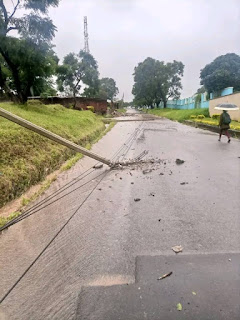
“The future ain’t exciting,” said one resident of Nairobi after a recent heavy downpour and flooding. “But I have kids. I have to believe there’s still time to do something.”
The shift from despair to action
That tension. Between what is coming and what can still be changed, defines the current moment in environmental journalism and policy alike. The science is unequivocal. The trajectory we are on is dangerous. But the corollary, often underreported, is that the trajectory can still bend.
Across the country, individuals, neighbourhoods, and municipalities are proving that adaptation and mitigation are not abstract concepts. They are choices.
Take solar energy. Once a niche investment, rooftop solar has become one of the most accessible forms of clean energy generation. It reduces reliance on fossil fuels, lowers monthly utility costs. Crucially, it demonstrates that climate action and economic self-interest need not be at odds. “It’s good for the planet and your pocketbook,” said one homeowner in Kisumu county who installed panels after the state’s last grid emergency. “That’s not a trade-off. That’s just common sense.”
Reforestation efforts are gaining similar traction. Trees are among the most efficient carbon-capture technologies available, and they cost nothing to deploy at scale when communities organize around them. Beyond carbon, they absorb airborne pollutants and release oxygen. A return to the most fundamental exchange between human life and the natural world.
Even small-scale habits are accumulating into meaningful shifts. Composting, once the domain of dedicated gardeners, is being adopted by urban households looking to reduce methane emissions from landfills while creating free, chemical-free fertilizer. And on hot days, a growing number of people are opting for ceiling fans over air conditioning. A minor adjustment that, multiplied across millions of homes, significantly reduces peak energy demand and the fossil-fuel emissions that come with it.
What comes next
None of these actions alone will reverse a century of industrialization. But together, they form the foundation of something larger. A cultural shift toward treating the climate crisis not as an unsolvable tragedy, but as the defining challenge that demands participation at every level.
The future ain’t exciting. Not yet. But the choices being made today will determine whether that sentence ends as a prophecy or a warning heeded too late.
In neighbourhoods where solar panels are spreading, where trees are being planted along once-bare streets, where compost bins sit beside recycling bins and fans hum instead of air conditioners, a different story is being written. It is quieter than the headlines about fires and floods. But it is no less real.
And for those who are paying attention, it offers a glimpse of something that, until recently, felt difficult to imagine.
A future that could, with enough momentum, become exciting after all.


Comments
Post a Comment