A REFLECTION ON CLIMATE JUSTICE, IPCC SCIENCE, AND THE WEIGHT OF MALAWI'S BURDEN
By Brian Onali Nduw
There is something
profoundly humbling about standing before a room full of young people and
telling them the truth about their planet. Not a softened, palatable version.
The full truth. The kind that lives in peer-reviewed reports, that is argued
over in Swiss conference rooms, and that eventually washes up, quite literally,
on the shores of countries like Malawi, in the form of cyclones, droughts, and
flooded roads.
I am Kenyan. I came to
Malawi to study, chasing knowledge across borders the way the climate crisis
itself crosses them. Indifferent to where you were born or what your country
emits. When the Head of the Department of Forestry and Environmental Management
at Mzuzu University identified me as someone with grounding in climate finance
topics and asked me to stand alongside Mr. Luke Mwakuluni, a Forest Extension
Officer with the Co-operative Development Foundation of Canada, I felt both the
honour and the gravity of what we were being asked to do. We were not simply
presenting slides. We were translating science into conscience, and conscience
into action, for the very generation that will inherit whatever we leave
behind.
The Report That Could No
Longer Be Ignored
On Saturday, November 4,
2023, our presentation at the Children & Youth Climate Justice Festival
(Malawi), was anchored in the Intergovernmental Panel on Climate Change’s Sixth
Assessment Report, the AR6. A body of work so comprehensive, so methodically
constructed, that ignoring it would require a deliberate act of will. Finalised
at the Panel’s 58th Session in Interlaken, Switzerland, in March 2023, the AR6
Synthesis Report distilled contributions from three working groups: one
examining the physical science of climate change, another mapping its impacts,
vulnerabilities and adaptation pathways, and a third assessing mitigation
options. Supplementing these were special reports on oceans, land use, and the
tantalisingly, terrifyingly specific question of what a world warmed by exactly
1.5 degrees Celsius would look like.
The IPCC itself, the Intergovernmental Panel on Climate Change, is not a research institution in the traditional sense. It does not conduct original experiments. What it does, drawing from 195 UN member states, is synthesise the best available science and translate it into language that policymakers can act upon. Its secretariat sits in Geneva. Its moral weight, however, belongs to every community living downstream of decisions made in rooms they were never invited into.

The undeniable: What the
science now tells us
Standing before those
young faces at Mzuzu University, I needed to say clearly what the 2021
component of the AR6 established beyond reasonable scientific dispute: human
activities are causing climate change. This is no longer a hypothesis. And the
consequences are not abstract projections painted onto distant futures. They
are already here: heatwaves grown longer and fiercer, rainfall events that
arrive in catastrophic bursts, droughts that hollow out harvests before they
begin.
What the 2023 Synthesis
Report adds to this foundation is a picture of compounding crises. Water
scarcity and disrupted food production are not separate problems but
intertwined ones. Human health and well-being are bound to ecosystem health.
Cities, settlements, and infrastructure are being tested in ways they were not
designed to withstand. Species are shifting their ranges. Seasons are shifting
their timing. The Earth’s climate system is changing at a rate unprecedented in
human memory, driven unmistakably by human influence.
There is no going back
from some of these changes. That sentence, simple and declarative, landed in
that room with the weight it deserved. The permafrost that once locked away
ancient carbon is releasing it. Some trajectories are now locked in, whatever
we do next.
But, and this is where I
chose to lean forward and speak with conviction rather than resignation, some
changes can still be slowed. Others can be stopped entirely. The lever is a
strong, rapid, and sustained reduction in carbon dioxide, methane, and other
greenhouse gases. The science is unambiguous on this point. We are not
helpless. We are merely undecided.
A country that did not
cause this
The photographs on our
slides were not stock images sourced from international archives. They were
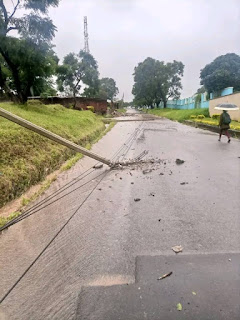
Malawi’s own. Communities in Balaka drawing water from unprotected sources.
Roads in Blantyre washed away by Cyclone Freddy. The village of Madani, a name
that now carries the particular sorrow of places that weather has unmade,
photographed by D. Mataka of CARE Malawi in the immediate aftermath of a storm
that should not have been as powerful as it was.
Cyclone Freddy, which
struck Malawi in early 2023, became one of the longest-lasting and most
energetically intense tropical cyclones ever recorded. It did not ask Malawi’s
permission. It did not inquire about Malawi’s share of global greenhouse gas
emissions, which is, for context, less than five percent of Africa’s total, and
Africa as a whole contributes less than five percent of the world’s emissions.
Malawi has given almost nothing to this crisis. It is receiving, in return,
some of its most devastating consequences.
This is the central
injustice that the word “climate justice” is attempting to name. It is not
rhetorical. It is statistical. The IPCC quantifies it precisely: people in the
most climate-vulnerable areas are up to fifteen times more likely to die in
floods, droughts, and storms than those living in more resilient regions.
Millions are already facing acute food insecurity and reduced water security.
The heaviest burden falls on parts of Africa, Asia, Central and South America,
least developed countries, small island states, and Arctic communities, places
that, almost without exception, have contributed the least to the problem they
are now absorbing.
 |
| Mr. Luke Makuluni and Brian Onali Nduw during the presentation |
What Kenya has built –
and what it has not yet fixed
I do not say any of this
from a position of detachment. Kenya, my home, has spent the better part of two
decades constructing what is arguably one of the more sophisticated climate
finance and governance architectures on the African continent. I know its
strengths. I also know, with the particular intimacy of someone who has worked
inside its logic, where the scaffolding is still missing.
Kenya established the
National Climate Change Council to provide high-level political oversight and
coordination of the country’s climate response, chaired by the President, with
cabinet-level representation across ministries. This is not window dressing. It
signals that climate governance, at least in design, sits at the apex of
national decision-making rather than buried in a technical department.
Alongside this, Kenya has cultivated a close institutional relationship with the
Green Climate Fund, the world’s largest dedicated climate finance mechanism.
The country has worked to establish itself as a credible GCF partner,
developing the national systems and fiduciary standards required to access and
manage international climate funding. Kenya’s National Designated Authority to
the GCF sits within the National Treasury, a deliberate placement that reflects
an understanding that climate finance is not merely an environmental issue but
a fiscal and development one.
On the legislative side,
Kenya’s Climate Change Act of 2016, and its subsequent amendments, gave
statutory force to what had previously been policy aspiration. It mandated
climate change mainstreaming across sectors, required County Governments to
develop their own climate action plans, and created accountability mechanisms
for climate finance, at least on paper. This legislative progress, measured
against the broader African landscape, is genuinely notable. It represents the
kind of enabling environment that the IPCC identifies as foundational to
accelerating climate action.
I drew on all of this
when standing before that Mzuzu University audience. Not to boast. Kenya is not
a climate success story, and I would resist any framing that suggests
otherwise, but to demonstrate that institutional architecture is possible. That
governance frameworks can be built. That a country can move from aspiration to
statute, from policy to implementation structure, and that this matters
enormously to the speed and equity of the response.
But I also spoke, with
equal precision, about the gaps. Because if the architecture exists and the
crisis is still deepening, then something in the mechanism is failing.
Kenya’s private sector
remains insufficiently engaged in climate finance flows. The gap between public
climate commitments and private capital mobilisation is wide and largely unaddressed.
The country has struggled to create the risk-sharing instruments, blended
finance structures, and regulatory incentives that would draw commercial banks,
insurers, and investors into genuine partnership with climate adaptation and
mitigation goals. Green bonds have been issued. Climate-related financial
disclosure frameworks have been discussed. But the private sector, which
commands resources and reach that public institutions cannot match, has yet to
be structurally integrated into Kenya’s climate finance ecosystem in any
durable way.
More troublingly, Kenya
lacks robust, functional systems for tracking and reporting climate finance
flows. Knowing how much money is committed to climate action is one thing.
Knowing how much actually reaches the intended communities, in what form,
through which channels, and with what measurable effect, that is an entirely
different and far harder task. Without reliable tracking systems,
accountability becomes impossible. Without accountability, the risk of climate finance
being captured by intermediaries, misallocated, or simply lost in bureaucratic
transfer is substantial. The IPCC’s enablers for accelerated climate action,
effective multilevel governance, international cooperation, trust, sharing of
benefits, cannot be meaningfully evaluated if the financial flows themselves
are opaque.
I carry these two
realities together: what Kenya has managed to build, and what it has not yet
managed to fix. Both are instructive when looking across the border at Malawi.
What we have, and what we
lack
It would be dishonest to
stand before young Malawians and present only grievance without acknowledging
what their country has built in response. Malawi has a Disaster Risk Management
Law, updated in 2023, itself a grim marker of the times, revised because
Cyclone Freddy made the old framework inadequate. The country has a National
Climate Change Management Policy, a National Disaster Risk Reduction Framework,
risk communication strategies, and contingency plans. There is a Department of
Climate Change and Meteorological Services. There are NGOs, civil society
organisations, research institutions, and individuals working at every level
from village to capital.
These are not small
things. They are the architecture of a national response, assembled under
difficult circumstances, and they represent genuine commitment.
But the challenges are
equally real, and naming them was part of our responsibility. Policies struggle
to keep pace with the speed at which climate conditions are shifting, the DRM
Law’s 2023 revision being a case in point, reactive rather than anticipatory.
Climate vulnerability analysis remains limited, making it difficult to design
interventions precisely targeted at those most at risk. Access to communication
about climate-related risks is low, particularly in rural areas. Early warning
systems are underdeveloped and poorly integrated across hazard types. Awareness
of climate risk is measurably lower among women and people with less formal
education, precisely the groups who tend to be most exposed to its
consequences.
And underneath all of
this, there is a financing gap. Developing countries like Malawi require
external funding to meet their adaptation needs. The IPCC’s 2023 report is
clear that sufficient global financing exists to address the climate crisis at
scale. The question is not one of scarcity but of distribution and political
will.
For the children and
youth in that room
We titled our presentation,
in part, around children and youth climate justice, and there was a reason for
that beyond the name of the festival hosting us. The IPCC’s reports, for all
their technical rigour, are increasingly making room for a broader cast of
actors in the climate story. The diversity of people engaged in climate action
is reflected more substantially in the AR6 than in any previous assessment
cycle. Young people are not merely the future recipients of whatever adults
decide. They are, right now, participants in a global negotiation about what
kind of world gets built.
That means their voices
belong in policy processes. It means data and evidence should be made accessible
to them, not locked behind paywalls or specialist vocabularies. It means that
when we design climate initiatives, youth and vulnerable groups must be
included not as afterthoughts but as architects.
The call to action that
closed our presentation was not performative. It was practical: increase
financing for climate resilience; accelerate technology transfer; commit to
data-sharing and global partnership; enforce the laws that exist rather than
waiting for the next disaster to prompt revision; stop allowing narrow vested
interests to shape policies that were written to protect everyone.
A Kenyan, standing in
Malawi, thinking about both
I returned home from that
Saturday session at Mzuzu University carrying something difficult to name precisely.
Gratitude, certainly, for the invitation extended by the Department, for the
partnership with Mr. Mwakuluni, for an audience of young people who asked hard
questions and refused easy answers. But also a kind of renewed seriousness
about the work ahead, sharpened by the comparative lens that my Kenyan
background kept pressing into the conversation.
Kenya’s National Climate
Change Council, its GCF partnership, its Climate Change Act – these are not
abstract reference points for me. They are the institutional landscape. And yet
Kenya, for all that legislative and governance progress, has not solved the
private sector problem. It has not built the tracking systems that would make
climate finance accountable end-to-end, from donor pledge to community outcome.
If a country that has invested this heavily in the architecture still carries
these gaps, then the gaps are not incidental. They are structural. They reflect
something about the political economy of climate finance globally, who benefits
from opacity, whose interests are served by keeping private capital at arm’s
length from binding climate commitments.
Malawi does not yet have
Kenya’s institutional depth. But Malawi also has an opportunity that Kenya, now
embedded in its own established frameworks, finds harder to seize: the chance
to design new systems with these failures already in view. To build tracking
and reporting mechanisms from the ground up rather than retrofitting them onto
a pre-existing architecture that was not designed with accountability as its primary
feature. To create private sector engagement frameworks that learn from where
Kenya’s instruments have fallen short.
The IPCC’s Sixth
Assessment Report does not let any of us off the hook. It documents what is
happening. It maps what is possible. It identifies what stands between the two:
political commitment, effective governance, international cooperation,
equitable financing, technology transfer, and the honest sharing of diverse
knowledge, including the knowledge held by communities who have been living
with environmental fragility for generations.
We are all, Kenyans and
Malawians and everyone else who stands at the intersection of forestry,
environmental management, and climate justice, working within a story much
larger than any single presentation. The IPCC will issue its Seventh Assessment
cycle in due course. The atmosphere will not wait for it.
The children in that room
at Mzuzu University will not wait either. And they should not have to.


Comments
Post a Comment